




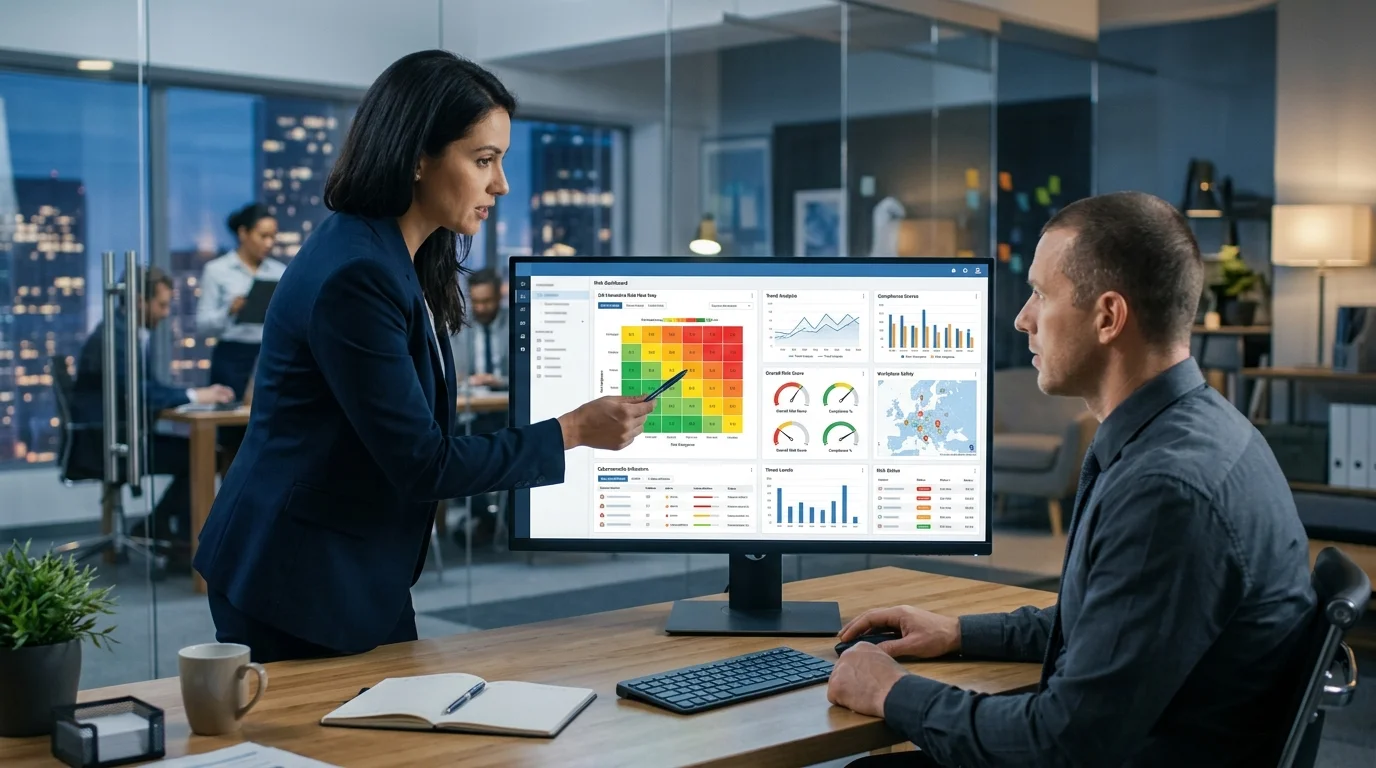
Managing operational uncertainty has moved beyond the limits of manual documentation. For decades, organizations relied on disconnected Excel files, static registers, and annual paper-based audits to track workplace hazards, data privacy obligations, and compliance standards. As regulatory frameworks expand and supply chains grow more interconnected, these legacy methods consistently fail to deliver real-time operational visibility. Deploying dedicated risk assessment software allows organizations to replace fragmented data silos with centralized, continuous risk oversight.
Rather than treating compliance as a reactive scramble before an audit, modern platforms aggregate operational data across departments, automate hazard identification, and maintain verifiable digital paper trails.
Quick-Pick Decision Matrix
| Platform | Primary Target Sector | Key Focus Area | Deployment | Best For |
| Mitti (by SafetyCulture) | Workplace Safety / EHS | Mobile audits, corrective actions | Cloud / iOS / Android | Field teams and frontline inspections |
| KPA Flex | Industrial & EHS | Compliance calendars, OSHA reporting | Cloud / Mobile | Manufacturing and industrial facilities |
| Velappity | Facilities & Field Services | Digital RAMS, risk registers | Cloud / Mobile | Multi-site contractors and engineers |
| DataGuard | InfoSec & Data Privacy | GDPR, ISO 27001, NIS2 data mapping | Cloud SaaS | European and mid-market compliance |
| Hyperproof | Enterprise GRC / IT Security | Control crosswalks, continuous monitoring | Cloud SaaS | Multi-framework cybersecurity teams |
| LogicGate Risk Cloud | Enterprise ERM / Cyber | FAIR quantitative risk modeling | Cloud SaaS | Dollar-value risk exposure reporting |
| MetricStream | Global Enterprise GRC | Multi-subsidiary governance, ERM | Enterprise Cloud | Complex financial and enterprise scale |
2. Core Capabilities of Enterprise Risk Assessment Platforms
Selecting the right solution requires evaluating whether a platform delivers genuine operational automation or merely acts as a digital filing cabinet. High-performing risk assessment software provides several essential technical functions:
-
Automated Risk Intake and Standardized Templates: Digital intake forms allow field workers, project leads, or system administrators to log hazards instantly. Pre-configured templates for Job Safety Analysis (JSA), Risk Assessment and Method Statements (RAMS), and Data Protection Impact Assessments (DPIA) ensure uniform data collection across the entire organization.
-
Control Crosswalks and Framework Harmonization: Modern enterprises must often comply with multiple overlapping standards, such as ISO 27001, SOC 2, HIPAA, and NIST CSF. Control crosswalk capabilities allow teams to map a single internal security policy to multiple frameworks simultaneously, eliminating redundant auditing efforts.
-
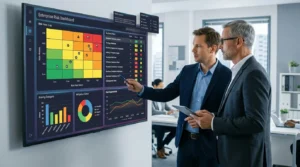
Dynamic Risk Heat Maps and Scoring Engines: Replacing static formulas, interactive risk matrix tools recalculate risk scores automatically when control effectiveness changes, providing live graphical representations of organizational exposure.
-
Role-Based Access Control (RBAC) and Audit Trails: Granular permission structures ensure external contractors, internal auditors, and department heads see only relevant operational assets while every modification, review, and mitigation action is recorded with an immutable timestamp.
3. The Core Pillars of Risk Assessment: Breakdown by Operational Sector
Risk management is not a one-size-fits-all discipline. Organizations typically deploy risk platforms across four core operational categories:
Environmental Health and Safety (EHS)
Workplace safety software focuses on physical safety, hazard identification, and incident prevention in high-risk environments such as construction sites, production floors, and chemical facilities. These platforms track compliance with regulatory bodies like OSHA and standards like ISO 45001, providing mobile-first tools to record slips, machine faults, chemical exposures, and corrective actions directly from the field.

Cybersecurity and IT Risk Management
Digital assets, cloud infrastructure, and sensitive consumer data require continuous vulnerability monitoring. Cybersecurity risk management software links digital asset inventories to compliance controls, scanning for misconfigurations and ensuring alignment with standards like SOC 2, PCI DSS, and ISO 27001.
Third-Party Risk Management (TPRM)
Modern organizations rely on extensive networks of vendors, cloud service providers, and logistics partners. TPRM solutions automate vendor security questionnaires, evaluate third-party compliance postures, and track external supply chain vulnerabilities before vendor lapses impact parent operations.
Enterprise Risk Management (ERM)
Enterprise risk management software centralizes strategic, financial, operational, and reputational risks across all corporate divisions. ERM tools connect executive decision-making directly with line-of-business risks, giving leadership a unified view of organizational resilience.
4. Top 7 Risk Assessment Solutions Ranked and Reviewed
1. Mitti (by SafetyCulture)
Mitti is an operational safety platform designed for frontline execution and field-driven hazard identification.
-
Core Strengths: Exceptional mobile usability, deep template libraries for safety inspections, and automated incident tracking with corrective action assignment.
-
Standout Capability: Full offline functionality that enables field workers to conduct comprehensive safety audits in remote environments and automatically sync data once reconnected.
-
Target Audience: Operations leads, construction managers, and field safety supervisors.
2. KPA Flex
KPA Flex provides an industrial-grade environmental health and safety platform built to handle complex manufacturing and field operations.
-
Core Strengths: Robust compliance tracking, interactive training modules, and real-time OSHA incident reporting logs.
-
Standout Capability: Integrated safety training tracking that automatically links employee certifications directly to task authorizations and hazard profiles.
-
Target Audience: EHS directors in manufacturing, oil and gas, and heavy logistics.
3. Velappity
Velappity is a specialized digital inspection and compliance platform tailored for field engineers, service contractors, and multi-site operations.
-
Core Strengths: Seamless creation of digital Risk Assessment and Method Statements (RAMS) and centralized risk registers.
-
Standout Capability: Streamlined client-facing report generation that converts field data collection directly into branded compliance documents within minutes.
-
Target Audience: Building services engineers, water treatment contractors, and field compliance auditors.
4. DataGuard
DataGuard combines software automation with compliance expertise to streamline data privacy and information security workflows.
-
Core Strengths: Native support for GDPR, NIS2, and ISO 27001 frameworks with automated data asset mapping.
-
Standout Capability: Interactive Data Protection Impact Assessment (DPIA) modules that identify privacy exposure across corporate assets.
-
Target Audience: Data protection officers and mid-market IT security managers.
5. Hyperproof
Hyperproof is an enterprise GRC platform built to eliminate audit fatigue through continuous controls monitoring and centralized evidence management.
-
Core Strengths: Powerful control crosswalks that map single controls across more than 100 compliance frameworks.
-
Standout Capability: Automated evidence collection via deep API integrations with major cloud, developer, and identity ecosystems.
-
Target Audience: Fast-growing technology companies, fintechs, and multi-framework IT compliance teams.
6. LogicGate Risk Cloud
LogicGate Risk Cloud provides a no-code governance and risk architecture designed for custom workflows and advanced risk quantification.
-
Core Strengths: Visual drag-and-drop workflow designer and flexible risk scoring modules.
-
Standout Capability: Native quantification engines utilizing the FAIR methodology to model financial loss expectancy in concrete dollar values.
-
Target Audience: Enterprise risk managers and governance executives requiring board-level financial risk reporting.
7. MetricStream
MetricStream is an established enterprise GRC platform built for complex, global organizations with intricate operational structures.
-
Core Strengths: Comprehensive coverage across operational, cyber, regulatory, and third-party risk management.
-
Standout Capability: Advanced predictive risk analytics and multi-tier organizational risk rollups across global subsidiaries.
-
Target Audience: Large financial institutions, healthcare networks, and multinational enterprises.
5. Moving Beyond 5×5 Heat Maps: The Shift to Quantitative Risk Analysis
Standard 5×5 color grids that rate likelihood and severity on a 1-to-5 scale remain common in basic safety reviews, but they carry distinct limitations for enterprise decision-making:
Subjective scoring often leads to inconsistent categorization: one manager may rate a server outage as medium risk, while another classifies it as severe.
To overcome this ambiguity, leading enterprise risk assessment software incorporates the Factor Analysis of Information Risk (FAIR) framework. FAIR breaks risk into measurable components: Threat Event Frequency and Loss Magnitude. By running Monte Carlo simulations across these financial variables, the software calculates precise metrics such as Annualized Loss Expectancy (ALE). This lets security and risk leaders justify capital investments to executive boards with real financial projections rather than colored squares.
6. Step-by-Step Migration: Transitioning from Excel to Modern Software
Transitioning from legacy spreadsheets to a cloud platform requires a structured approach to maintain data integrity and user adoption:
-
Audit and Cleanse Legacy Registers: Export and review all active Excel registers. Remove obsolete assets, merge duplicate hazard listings, and eliminate deprecated controls.
-
Standardize the Organizational Risk Taxonomy: Establish uniform definitions across business units for likelihood, impact, asset criticality, and control effectiveness before importing data.
-
Map Framework Controls and Harmonize Overlaps: Use control crosswalking to link existing corporate policies directly to international standards like ISO 27001, OSHA, or SOC 2.
-
Establish Corrective Action and Incident Workflows: Configure automated escalation triggers and Corrective and Preventive Action (CAPA) routines so that high-severity assessments immediately assign tasks to responsible stakeholders.
-
Conduct Role-Based User Training: Train field personnel and system administrators on relevant interfaces, ensuring frontline teams understand mobile intake while analysts master dashboards. For internal awareness campaigns, many compliance teams use digital documentation tools or the Sway computer program to build interactive training modules that explain updated safety protocols and risk procedures to employees.
7. Business Impact and Measuring True Software ROI
Investing in specialized risk assessment software yields measurable financial and operational returns:
-
Lower Insurance Premiums: Insurance underwriters evaluate an organization’s demonstrable risk posture when setting cyber and general liability premiums. Showing continuous monitoring and verified audit logs directly improves underwriting terms.
-
Audit Preparation Efficiency: Automated evidence gathering reduces the manual effort spent assembling documents for external auditors by up to 60 percent, freeing technical teams to focus on core operations.
-
Proactive Hazard Mitigation: Digitizing risk identification in the field shortens the time between hazard discovery and corrective action execution, directly preventing costly workplace injuries and regulatory fines.
8. Implementation Traps to Avoid
-
Over-Configuring Workflow Notifications: Triggering email alerts for minor score shifts creates notification fatigue. Configure alert thresholds so that only critical issues notify senior leaders.
-
Neglecting Frontline Mobile Experience: In field services and manufacturing, software adoption depends entirely on mobile usability. If field inspectors find digital forms slower than clipboards, data entry will stall. Prioritize intuitive mobile interfaces with full offline support.
-
Overlooking Third-Party Dependencies: Assessing internal systems while ignoring third-party vendors leaves major blind spots. Ensure your platform integrates vendor evaluations into your central risk register.
FAQs
What is risk assessment software?
Risk assessment software is a digital platform designed to identify, evaluate, monitor, and mitigate operational, environmental, financial, and digital security risks. It replaces static spreadsheets with real-time analytics, automated workflows, and centralized compliance reporting.
How does risk assessment software improve regulatory compliance?
It maintains digital audit trails, maps internal controls to regulatory standards like OSHA, ISO 27001, and GDPR, and alerts administrators when controls become outdated or ineffective.
Can risk assessment software function offline for remote field sites?
Leading mobile-first platforms include offline synchronization, allowing field workers to complete inspections and log hazards without cellular coverage. The data syncs automatically once an internet connection is re-established.
What is the difference between qualitative and quantitative risk assessment tools?
Qualitative tools rank hazards using descriptive scales (such as low, medium, or high), whereas quantitative tools calculate loss exposure in concrete financial terms using statistical modeling frameworks like FAIR.
How long does it take to implement risk assessment software?
Standard cloud-based EHS and inspection apps can be deployed within days, while complex enterprise GRC platforms requiring multi-department API integrations and custom workflow configurations typically take between 6 and 12 weeks.